Betty Spadaro
Oral History Interview
Interviewed by Joseph Burke
October 22, 2021
In Glen Lake, NY
Interview audio can be found at: https://youtu.be/R4QVPzmGpJU
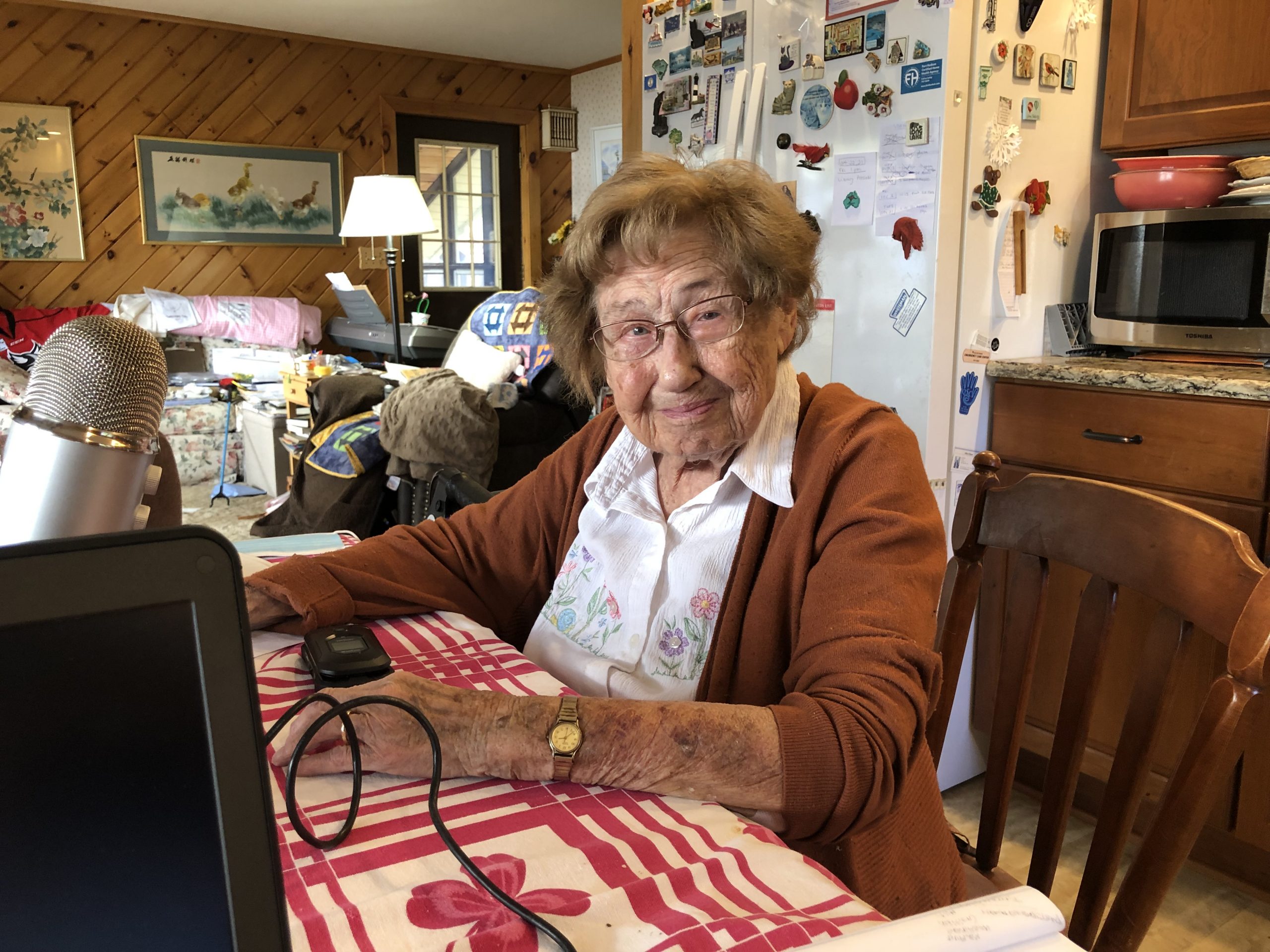
For the Altamont Free Library Oral History Project
Supported by the Marijo Doherty Memorial Fund
https://scribie.com/files/36230035fc78401090ac5f7342483a503391ab17
0:00:00.0 Joe Burke: Here, okay. So please say your name and give us your birthday.
0:00:09.6 Betty Spadaro: I’m Betty Spadaro. I was born during September 18, 1918 when the big flu epidemic was on the go.
0:00:29.2 BURKE: So you were born during the Spanish Flu, so this is not your first pandemic that you’ve lived through.
0:00:34.3 SPADARO: This is the world War I.
0:00:35.2 BURKE: The World War I…
0:00:38.6 SPADARO: End. Had just finished.
0:00:39.5 BURKE: Had just finished, even before the first Memorial Day, even before the first November 11th, the Armistice?
0:00:49.1 SPADARO: Yes.
0:00:49.8 BURKE: That’s amazing. Can you tell me something about your mother?
0:00:55.0 SPADARO: My mother was a very hard worker and wanted me to be well educated, and I followed what she asked me to do, or tried to do for me.
0:01:11.9 BURKE: Where was she born?
0:01:13.1 SPADARO: She was born in Montgomery County. Out in the… On a farm with seven other sisters and brothers.
0:01:27.4 BURKE: Who was her maiden name?
0:01:29.9 SPADARO: Horton, the Horton’s were quite popular and still are in a place called Charleston Four Corners, which is when you go past it, anybody says this is Charleston Four Corners, they’ve past it before they’ve said it.
[laughter]
0:01:51.6 BURKE: What about your father? What was his name?
0:01:54.4 SPADARO: His name was Virgil Allen.
0:01:56.7 BURKE: Mm-hmm. Where was he born?
0:02:01.0 SPADARO: He was also born in Montgomery County, in that area.
0:02:06.8 BURKE: How did they meet?
0:02:10.4 SPADARO: Probably at a dance.
0:02:17.9 BURKE: And where were you born?
0:02:20.1 SPADARO: I was born in St. Mary’s Hospital, when the ambulances were coming in full force and people were dying, right and left. And my mother had a friend who lived in Amsterdam and said, “Why don’t you come after you’re released,” which was probably six or seven days after I was born. They kept people in the hospital longer in those days. “And because your mother and your father and uncle are all with the flu, and it would prevent the child and you from getting this flu.” So with… That’s where we went, in Amsterdam. It made it wonderful for my mother.
0:03:26.1 BURKE: Did you have siblings? Did you have brothers or sisters?
0:03:30.6 SPADARO: None.
0:03:31.3 BURKE: No? So you were an only child?
0:03:33.4 SPADARO: Right.
0:03:34.1 BURKE: That’s interesting. So you went to live in Amsterdam. What do you remember about Amsterdam when you were a child?
0:03:46.5 SPADARO: Amsterdam had many foreign people there, because they were working on them beautiful carpets. As anybody stood beside the river, you might see beautiful purples rolling down and near the shore, or reds or yellows and so forth. It’s naturally… It was coming from the mills, and many of these people who were working there were Polish. No Puerto Ricans those days like it is now, and of course, I received… I started at grade seven in the Junior High School, and then I left it at grade nine, in the middle of the school, middle of the term, to live in Schenectady with my mother’s cousin for my high school education.
0:05:03.8 BURKE: What was the name of your high school?
0:05:10.5 SPADARO: Nott Terrace.
0:05:11.7 BURKE: Nott Terrace high school. So very close to the Union College campus?
0:05:16.8 SPADARO: Correct.
0:05:17.9 BURKE: Interesting. Do you remember any teachers that were very inspiring to you?
0:05:26.0 SPADARO: Many teachers. Mrs. Tilly and Dr. Johnson. My algebra teacher, I liked her, but I wasn’t very good with Algebra. [chuckle] I can’t think of her name right now, started with… My English teacher, wonderful person. Offhand, I can’t quickly think of their names immediately.
0:06:01.0 BURKE: Then you became a teacher later, so were there… Do you remember a time when you were in school when you realized that you might want to become a teacher?
0:06:17.0 SPADARO: I wanted to become a teacher when I was about five years old. And my mother bought a little small desk-like. It would fold up, and when other children came to my house, I made them [chuckle] be a student and I was a teacher.
0:06:38.9 BURKE: Yes.
0:06:39.9 SPADARO: And I met a person on my life, and when I was a sixth grader, and I saw so much of her. Her father was a pro with The Antlers in Amsterdam, and I would have her be a student, only she was a year older than I am. And I finally… I lost track of her for years, and I finally met up with her. I went to her nursing home to see her, and she said, “Remember how much you wanted to become a teacher.” [chuckle]
0:07:22.6 BURKE: When you graduated, you went to college. Was that unusual?
0:07:30.4 SPADARO: Yes, it was. I read in the paper, just lately, only 4% women were going to college those years, 4%. I couldn’t believe it.
0:07:42.5 BURKE: How did you afford to go to college?
0:07:46.6 SPADARO: When I tell you, it sounds as if I were lying. I lived on $4 a week, which took in two dollars and a half for my room, something to eat, which was usually often oranges, and what was the other thing? There was another thing that I ate, and that was it. And then I had 10 cents to go to the theater, or going out. No time for buying any clothes. No money.
0:08:29.3 BURKE: Yeah, and did your parents pay it? Or did you work for the…
0:08:34.8 SPADARO: I worked during the summers down in the Catskills, doing waitress work in the summers. In some weeks, I’d make more per week than I did as [chuckle] waitress than I did as a teacher, ’cause I only started with $100 a month.
0:08:56.4 BURKE: Where would you work in the Catskills? Was it at some of the resorts?
0:09:03.7 SPADARO: Yes, it was East Durham.
0:09:04.5 BURKE: East Durham. So some of the Irish resorts.
0:09:07.0 SPADARO: Irish.
0:09:07.4 BURKE: That’s right.
0:09:08.2 SPADARO: So we learned all the Irish. And sometimes they take us out on dates.
0:09:12.9 BURKE: What was the… Do you remember the names of the resorts that you worked at?
0:09:23.8 SPADARO: I can’t exactly think about it. I haven’t thought about her name lately, but she was Irish and her brother was Irish. They’re both… It was a woman and… Sister and brother ran it. Yeah, I think a Jewish group owns it.
0:09:39.4 BURKE: Interesting. So many of them are gone, but that one is still there. Huh. That must have been very interesting because this would have been…
0:09:53.5 SPADARO: In the ’30s.
0:09:55.0 BURKE: In the ’30s.
0:09:56.3 SPADARO: Right.
0:09:57.4 BURKE: During what we call The Great Depression.
0:10:00.2 SPADARO: Yes, it certainly was. That was a horrible experience.
0:10:05.2 BURKE: Did you think of it as being The Great Depression at the time or is that just something that we think of it now?
0:10:14.2 SPADARO: Well, now I think back how horrible it was for everybody, but what made it easier for people is there were more farmers. And people would go out with their parents, with their uncles or aunts or relatives, and there they would secure their meat and their food. Now, we don’t have the farms, but it was not easy. 10 cents was big amount to have.
0:10:49.2 BURKE: How do you think the depression affected your parents?
0:11:00.1 SPADARO: Didn’t help with any [0:11:00.2] ____. It was very hard, especially men, ’cause they didn’t have jobs. And another thing, high schools, at that time, were not offering any guidance at all, and so a man, it would be difficult for him to find a job if he were not interested in farming.
0:11:26.5 BURKE: Yeah, what was your father’s occupation when he worked?
0:11:31.2 SPADARO: Well, he was mainly a musician.
0:11:33.8 BURKE: Interesting. What kind of a musician?
0:11:37.8 SPADARO: Trumpet. He couldn’t play the piano, but he played beautifully on the violin.
0:11:47.0 BURKE: Interesting. Was he in bands or orchestras?
0:11:52.3 SPADARO: At nights, yes, playing at the dance halls.
0:12:00.2 BURKE: Would he travel as a musician?
0:12:01.8 SPADARO: No.
0:12:02.2 BURKE: No, he just played… He just stayed local.
0:12:04.9 SPADARO: Mmm.
0:12:08.5 BURKE: So after you graduated from high school, you went on to college, and you lived on $4 a day, which is unbelievable. Where did you go to college?
0:12:21.0 SPADARO: Oneonta. Beautiful place.
0:12:26.3 BURKE: How did you choose Oneonta?
0:12:29.6 SPADARO: I think my guidance, Mr. Grey, he was a person that I always remember, suggested Oneonta, and then I knew of a person who had… Would substitute and she was… She had taken courses, I think, from Oneonta. Otherwise, I didn’t know about any of those state colleges at all. And I think we tend to be closer to Oneonta than in Schenectady, than we are Potsdam, Plattsburgh, and down to Hudson.
0:13:09.4 BURKE: Sure. I went to college in New Paltz, and… SUNY New Paltz, and as you know, that started out as a teacher’s college, but Oneonta must have been wonderful at the time.
0:13:22.4 SPADARO: But all it was, was just one brick building.
0:13:26.6 BURKE: One building.
0:13:27.4 SPADARO: One building.
0:13:29.2 BURKE: For all of the classes?
0:13:30.3 SPADARO: It’s been removed now, and they must have been… They were very smart, whoever was in charge of those… Building those in the late 1800s because there’s lots of land to each one, and it’s… I bet it’s a good three-quarters a mile away from the original one in the back. Wonderful, overlooking the city. It was just beautiful.
0:14:03.5 BURKE: And you studied education then when you were in college?
0:14:06.7 SPADARO: That was it, to be a teacher. There was nothing else taught, just teaching. And that is where I met my friends, and I kept them… We did not have dorms. We lived in houses, probably four or five people, students in a house. They were all over in the city of Oneonta, and many of them came from farms. There were some Long Island people there. I don’t think New Jersey. It was mainly Long Island because of state. And one person, she and I always wrote every week to each other after we graduated, and her… And she died three years ago, and her daughter comes from Ithaca about every six, seven weeks and stays overnight with me and does various things for me.
0:15:14.0 BURKE: That’s wonderful. In your house, would you take turns cooking? Who would do the cleaning? Who would do the dishes?
0:15:22.6 SPADARO: Each one did his own usually, because they each brought their own food.
0:15:32.2 BURKE: After you graduated with your bachelor’s degree, was that the end of your education?
0:15:43.1 SPADARO: No.
0:15:44.1 BURKE: No?
0:15:45.2 SPADARO: No. I wanted to have my master’s, which I accomplished, and then I have many, many points beyond that. I kept on going. I went down to Albany State and received my degree there, my master’s.
0:16:09.2 BURKE: What year did you graduate with your master’s?
0:16:12.3 SPADARO: 1961.
0:16:14.4 BURKE: 1961. So this was already after you’d been teaching for quite some time. Oh, that’s wonderful. So what year did you graduate from Oneonta?
0:16:24.6 SPADARO: ’39, from Oneonta.
0:16:26.8 BURKE: ’39. And did you know what you would do after graduation?
0:16:34.9 SPADARO: Oh, that was a horrible experience. When we stood in line, about 120 of us, I would guess, probably six had a job. Teachers, there’s a scarcity, then there are too many, then there’s a scarcity, and that’s the way it goes. This is interesting. My mother married a second time, and her husband was up in Altamont, in a grocery store, and he met up with a trustee of the Boys and Girls School he knew. And he, right away, he said to him, “You don’t happen to need a teacher, do you?” He said, “Yes, I do.” And my stepfather said, “Well, I have a step-daughter who is working down in East Durham right now, but she needs a job.” And he said, “She’s hired.”
[laughter]
0:17:50.3 BURKE: It should always be that easy, shouldn’t it? [chuckle] That’s amazing. So your mother re-married and moved to Altamont. Do you remember the first time that you came to Altamont?
0:18:05.9 SPADARO: I have to think. [chuckle] I just don’t remember that day.
0:18:13.8 BURKE: Was it before or after you got the job?
0:18:20.9 SPADARO: I was in Altamont before I got the job. Yes, I had been down there.
0:18:26.0 BURKE: To visit.
0:18:26.7 SPADARO: In Altamont, Yes.
0:18:32.4 BURKE: So you finished up your work waitressing in East Durham, and you came up to Altamont to begin teaching?
0:18:40.5 SPADARO: Well, naturally, the resort closed, and when it… Well, I think I left before it closed because they would continue on until October. We would all… All of us were college people. And at the end of August, we just went back home. And they gave us a little extra money, [chuckle] so we’d come back the next year, to bribe us a little.
0:19:12.2 BURKE: Do you remember the first time that you saw your new school and what you thought of it?
0:19:23.2 SPADARO: The first time that I saw the school?
0:19:26.3 BURKE: Yes.
0:19:26.6 SPADARO: Well, that August, after I had been doing my waitress work, my stepfather and mother took me up there to see the school. And my mother said, “You know the school… “Oh, she sent me a letter to tell me that I had the position. She said, “It is a dream. It’s just so wonderful, such a nice little school.” And I did have the letter, but I don’t know where it is right now, but I kept it. When we went into it, there was a radio, and red curtains, and movable like you were brought up with, and that was in the ’30s, 1939. In other words, the trustee had purchased this nice of… Some even, maybe 20 years later, still had them bolted right to the floor. With these, you could move all over the place. It was wonderful.
0:20:40.4 BURKE: How many… Can you close your eyes and describe the room?
0:20:46.3 SPADARO: It was just a plain… I can’t tell you dimensions, but it was not quite double of this area, which… What would that be? I’m thinking it was [0:21:04.0] ____. Would it be 40 feet maybe?
0:21:09.0 BURKE: Okay.
0:21:10.4 SPADARO: Something like that, across. It’s all there was to it. It was just that. And the bathrooms were… We’ll call them bathrooms. That was a long… There were three sections to that outside. One was pertaining to where the coal was, another the wood, another we’ll call the bathroom. [chuckle]
0:21:37.4 BURKE: How was it heated?
0:21:39.5 SPADARO: There was a big stove there, and he had to keep it going. Not easy, but I did it. I never asked the children to do anything with it. And we had to have… The custodian had to bring the water down. I never had the children get water, they had to bring it. If it’s a little walk, it’d take you about three minutes or four minutes to get from one to the other, or maybe five, carrying that water and a dipper, which I would not allow them to all use, and they had to all have their own little cups for water.
0:22:28.5 BURKE: Now, the first day of class that you were teaching, how many students did you have?
0:22:36.2 SPADARO: The very first day, and probably for the first two months, I only had three children from the same family, children that were very, very quiet. They acted as if they’ve never seen other people. Extremely, it was very hard to get them to talk.
0:23:03.5 BURKE: What was the family?
0:23:05.7 SPADARO: The name?
0:23:06.3 BURKE: Yes.
0:23:08.1 SPADARO: You’ve heard of it. It was Van Buren.
0:23:14.6 BURKE: Van Buren?
0:23:15.5 SPADARO: Up the hill.
0:23:19.9 BURKE: Were you nervous the first day?
0:23:22.7 SPADARO: You know, you’re always nervous the first day. When everyday comes along, there’s something about it I never was [chuckle] relaxed. Many teachers say the same thing.
0:23:38.5 BURKE: Later, the Pulliam family became some of your students, and that must have increased the size of your tutelage greatly.
0:23:49.8 SPADARO: All together different. Thoroughly different.
0:23:53.4 BURKE: How many Pulliams did you teach?
0:23:56.2 SPADARO: Four. And they still keep track of me. I have to get a hold of Paul. And I don’t have his… He’s changed his cell phone number, I think. He always meets me at the fair and takes me around in the car. And he didn’t this year because he wasn’t well. I could’ve write to him or call him.
0:24:23.1 BURKE: I’ve seen Joyce recently. I’ve seen Faith recently. And the first time that you and I met, unfortunately, was at Todd’s memorial service down in Altamont. Todd was one of my favorite patrons. He was a wonderful presence in the library. Which other Pulliam children did you have?
0:24:53.2 SPADARO: Those are the four. Abraham, he was the oldest. He was a… I think an engineer. He was very bright. They’re all very bright. And they’ve married, one, an English person, another Australian. [laughter] It’s interesting.
0:25:20.0 BURKE: You may know that, because Todd was so involved with museums for so much of his working life, that when he passed away, the family gave the library a little bit of money, and we’ve used that to begin a museum pass lending program, so that people can come in and take out passes so that they can go to all kinds of different museums. And I thought that was a very nice way to honor Todd, because he and his wife, Linda spent so much of their careers working in museums. Now what was the youngest student that you taught in the one room school house?
0:26:08.5 SPADARO: Probably, and I know it was, it was Gladys Short. She was such a sweet little girl, so cute and so particular. Neat, nice smile, just a lovely child.
0:26:24.9 BURKE: And how old was Gladys when she began school with you?
0:26:28.0 SPADARO: She was probably 5 1/2 or six, somewhere in there.
0:26:34.5 BURKE: And who was the oldest student that you had?
0:26:37.2 SPADARO: He was 15 when he came, he was a Pratt. And they lived down the Bozenkill Road. That family moved in after I had been there two months or so. And George Pratt said to me, “I’m going to be 16 in… ” I’ve forgotten how many months it was. It wasn’t very long, “Then I won’t be coming.” So he was 15.
0:27:07.7 BURKE: And how do you organize your day when you know that you’re going to have to be teaching a five-year-old and a 15-year-old.
0:27:16.3 SPADARO: You just had to sit down, figure out… Well, study the syllabus a little, what you’re supposed to be teaching and then go over the textbooks. And with what I had to work with, they tried to give me a good reading basis. I did the best I could, and I tried to make it interesting. We bake. Let me see. We didn’t bake because we didn’t have a stove, but we did have a… What do they call it? You just heat up things. Once in a while, we’d do that cocoa or something like that. And then I took them, three of them to see Gone with the Wind.
0:28:12.0 BURKE: Where was that playing?
0:28:13.9 SPADARO: In Albany?
0:28:14.7 BURKE: You took them on the train?
0:28:17.6 SPADARO: No. I can’t recall. We had to go by car, but I can’t recall who took us.
0:28:24.5 BURKE: I make that…
0:28:26.4 SPADARO: It might’ve been Frank Spadaro dropped us off. I can’t recall how we got there. I know it wasn’t a train.
0:28:38.3 BURKE: Was that the first movie that any of those kids had ever seen on the big screen?
0:28:42.8 SPADARO: The kids?
0:28:43.9 BURKE: Yeah.
0:28:44.2 SPADARO: Probably.
0:28:45.1 BURKE: Yeah.
0:28:45.5 SPADARO: I would imagine.
0:28:45.6 BURKE: That must’ve been an amazing experience for them.
0:28:51.7 SPADARO: Well, Herman, did you ever hear of Herman?
0:28:57.0 BURKE: No, not sure.
0:28:58.2 SPADARO: He was the head of the department… The highway of [0:29:03.2] ____. Before he died, there’s a little school house over on the shelf there that he gave me, and I went to see him, and he always was so kind to me. He was different than his sisters. They were kind, but they were so shy, but he had more of a conversation with me than the others.
0:29:39.1 BURKE: Tell me about some of the stories and some of the people that you knew in Altamont when you were teaching in the one room school house.
0:29:47.5 SPADARO: Well, first of all, the Pulliam’s, I’ll never forget, because that family’s always been great to me. But we’ll go right in Altamont. Some of the stories, I met so many. Well one…
0:30:07.8 BURKE: Nope.
0:30:08.7 SPADARO: Can you turn that off?
0:30:13.0 BURKE: I will pause it, yes…You were telling me some of the stories of people that you knew in Altamont when you were teaching at the one room school house.
0:30:22.8 SPADARO: Okay. Is John McClellan. He was very interested in baseball and not too interested in school, but I hear from him, he’s come up here with his… All nine books and so forth. And that’s one. Another one… I had so many. Like Lynn Howard is a teacher. And she’s lives down in Georgia, I think. She keeps track of me. The Howards, he was a teacher in a high school, a father, excellent in social service. She and a Paszkowski girl would come over to the house, and we’d bake cookies. And then they’d race around the house yelling chef. And when the cookies were done, and then they’d sit down. We practically eat them all. [chuckle] That’s the second one. Then there was a… There’s so many that I need to tell little about, though I have to think. But wasn’t prepared for this one.
[chuckle]
0:32:03.9 SPADARO: Oh, I know you’ve heard of Roger Keenholts.
0:32:08.2 BURKE: Sure.
0:32:08.7 SPADARO: I had him. He was very interested in museums and history and so forth. And did a great deal. He was very quiet. Beverly Crowns Harrington was an excellent student. You’ve probably heard of Beverly. She checks on me. She’s a wonderful person too. Then of course there’s one that we’d lost, quite a few I’ve lost. Right now, to my knowledge, and there are many I don’t know what happened to them, I’ve lost 75 of my students, I know I did. Barbi Chulay, I lost him. And another one was… Let’s see. Who would we say? Oh, The Druger’s son landed against a tree. The Druger’s is not there anymore. It’s closed, the drug store.
0:33:26.3 BURKE: No.
0:33:28.8 SPADARO: He was very instrumental in building that wall right there by the train station. He had people helping him.
0:33:42.0 BURKE: Interesting.
0:33:42.7 SPADARO: Then Bivona, I was so pleased that he had made such a wonderful life for himself and his family, and has moved up to Bolton Landing. And when I took 40 some people out on Lake George boat, I first invited John McClellan and John suggested Paul Tymchyn and Jenny. And then they suggested Gus Bivona, and I’ve had all of them.
0:34:26.7 BURKE: I saw Paul just yesterday, at the post office.
0:34:29.7 SPADARO: Did you?
0:34:30.6 BURKE: Yes.
0:34:30.9 SPADARO: Paul and I got along just great.
0:34:35.9 BURKE: Tell me how you came to know the Spadaro family?
0:34:40.3 SPADARO: Well, of course, as soon as I was hired, I met the trustee. And the method… I had no money to buy a car. So the method was that Jesse had a brother named Frank Spadaro, whose son helps me with everything. Now, so Frank, had a Buick, and he would transport the high school students down to Altamont. And after they were deposited at the high school, which was right around the corner from my house, he picked me up for five years and took me up to the school.
0:35:35.9 BURKE: And at the time, you were living on Park Street, yes?
0:35:39.2 SPADARO: Park Street. Right. And that was Shoddy Rowan’s father, who my mother married. You never met Shoddy, did you?
0:35:52.6 BURKE: No.
0:35:53.1 SPADARO: Do you know who he was?
0:35:54.7 BURKE: I don’t really.
0:35:56.2 SPADARO: He owned eventually a part of Altamont Enterprise. Worked with Asbury and Pino.
0:36:07.9 BURKE: Yes. And how did you meet your husband?
0:36:12.4 SPADARO: Well, it was the World’s Fair in New York City. And Frank was going to go to it.
0:36:21.8 BURKE: In 1946?
0:36:24.9 SPADARO: No, this was in 1939. And therefore, Patrick was his… His nephew came and did the transporting that… Those two days, they were in… They were… I’ve forgotten how many.
0:37:01.0 BURKE: Tell me about the 1939 World’s Fair. Having grown up on Long Island, we still see the Perisphere and the big globe and some of those things are from the 1964 World’s Fair, but some of them are… Some of the structures that are still there are from the ’39 fair.
0:37:20.9 SPADARO: I thought so.
0:37:22.1 BURKE: There was… I remember my mother telling me there’s a tall structure that doesn’t seem to have any point or purpose, but I was told by my mother that that’s where Franklin Delano Roosevelt’s helicopter landed when he came. I don’t think that that’s true. [chuckle] I think she might’ve been making that up.
[laughter]
0:37:46.1 BURKE: But tell me about the World’s Fair. Was that the first time that you went to New York city?
0:37:51.9 SPADARO: No. I went to New York city about… That’s probably the second time I went, but getting back to the first time, Oneonta offered, in our music class, always every year, a trip to the metropolitan opera in New York city. It cost a lot of money for me or everybody. And I really saved my wages from the summer, so I could go on that trip to New York as I’d never been there.
0:38:28.8 BURKE: So tell me about that trip to the ’39 World’s Fair with Patrick.
0:38:34.0 SPADARO: I never went with Patrick to the Fair.
0:38:36.3 BURKE: I’m sorry.
0:38:37.3 SPADARO: No, Patrick is the one that brought us back and forth while Frank was at the Fair.
0:38:45.4 BURKE: I see.
0:38:45.9 SPADARO: Substituted.
0:38:48.1 BURKE: Oh, I understand now. So what was that first meeting with Patrick, like?
0:39:01.1 SPADARO: I just sat in the car. He got me up there, and I left, and he came after me and [0:39:10.6] ____. Probably it was a terrible year, 1940. The snow blocked the road so… Those days, they did not have those snow plower working as well as they do now. And the road was closed for a month. So I had to walk in from the main road. And so one day he stopped, and [chuckle] just pulled on roadside, and he said, “You know, the snow banks are way up the telephone poles” and like a girl, I said, “Oh really?”
[chuckle]
0:40:01.1 SPADARO: “Would you like to see them?” Well, so he took me up, and there really… The snow was so high by those poles. You’ve heard of the Berne-Knox school. It’s about the first school that closes, and it was high. So that was my first date.
0:40:26.2 BURKE: That’s quite a date. Where would you go on other dates? Would you go out to dinner? Would you go dancing?
0:40:36.3 SPADARO: People didn’t go out to dinner too often in my days.
0:40:38.9 BURKE: As opposed to now. No.
0:40:39.0 SPADARO: They didn’t have the money. And so it was easier. I was a square dancer. Every Saturday night I went with somebody to square dance, especially on Brandle Road, which is now… There’s a church there, I think. No, it isn’t called Brandle. It’s called… What is that road that comes right out into… Just as you’re entering Altamont, there’s a road there to the right.
0:41:19.5 BURKE: Could that be Gun Club Road?
0:41:21.5 SPADARO: That’s it?
0:41:22.7 BURKE: Yes.
0:41:24.2 SPADARO: Gun Club.
0:41:25.2 BURKE: Yes.
0:41:26.8 SPADARO: That was Pat’s ranch. And there was very little liquor unless it was in their car. No one was ever intoxicated that I ever saw, and I was going there for a good four years. It was fun. And I roller-skated, too.
0:41:45.5 BURKE: Oh, where would you do that?
0:41:47.7 SPADARO: Well, it was called Hartman’s, but it burned, it was a beautiful place. Even had an organ as we skated. And there’s an also up in… Out of a township, I would take my horse and tie it to a tree and roller skate up there, Knox Cave, in Knox.
0:42:16.1 BURKE: Now, can I go back for a moment because the first story that I ever heard about you was that when the Pulliams… The Pulliams, hadn’t been coming to school. And so you rode to their house on your horse to tell them that they needed to come to school or they could come to school or to introduce yourself, is that right?
0:42:40.7 SPADARO: I don’t recall that.
0:42:42.1 BURKE: But you had a horse.
0:42:43.3 SPADARO: But I stopped when people would come out. Often as I rode, they’d come out from their houses.
0:42:50.0 BURKE: Okay. What was your horse’s name?
0:42:54.4 SPADARO: Tony.
0:42:57.7 BURKE: Tony. How did you come to have a horse? This is so unusual to me, of the idea of living on Park Street and having a horse is… I can’t quite get my head around it.
0:43:10.8 SPADARO: Well, often people like horses or they don’t at all. And we were talking about horses, Frank and I, and he said he just loved to have a horse, so I bought one. And he rode it, and others rode it, and everybody seemed to have a good time.
0:43:47.7 BURKE: When you begun teaching at Altamont Elementary, was it a hard decision to leave the Bozenkill school?
0:43:56.9 SPADARO: No, because I wanted more money. It was impossible for them to secure any extra money to increase my salary, so I called the superintendent, there were only three in that whole locality of the Albany, and Briggs, Mr. Harry Briggs, Henry Briggs. And he referred me to the other superintendent who knew that there was a position out of Delmar. And so he took me there and I was hired, and I stayed there that 1944 to summer of 1945, one year. Those people were so polite to me. They worked on the railroad there, and they couldn’t do enough for me. I enjoyed that year so much that it was a two-room school, and the other teacher on the… Grades four through six, I think. I think she only had two grades, but there were more than… And I had four grades, one through four. She was not interested in playing softball at all. She was older, and so this…
0:45:35.7 SPADARO: Her class came to me, the boys, would I play softball with them or act as umpire or something, and I said, “Well, I’ll do it, but if I make a mistake, I’ll admit it, but we gotta do what I say. I don’t want any arguments,” the so typical arguments. And they said, “We won’t, if you’ll only play with us because there’s nobody to organize it.” So they were so happy that I did it. I started in pitching, and then they were getting older and I let them pitch, and then I could say whether it was out or not. So we played softball when the weather was sensible.
0:46:33.7 BURKE: And then you began… After that year, you moved to Altamont Elementary, or it was Altamont High School at the time.
0:46:39.4 SPADARO: During my last year, the principal of the Altamont High School asked me… Called me on the phone and asked me if I’d like to have a job there. It’s the middle of the year, somewhere along there. Because I was there, I thought it was not right to just leave, and I said no. I sort of regretted it later. But anyway, I had that wonderful position for Delmar, so it came to be a happy year. But then while I was in Delmar area, I applied for a position. Well, what happened is, the person who had been there before me, and had, naturally, completed her year. I went in teaching two grades this time, fifth and sixth. The fifth graders were… Oh, I’ll never forget them. I can almost remember just about everybody in that class. And the sixth graders were mainly boys that could care less about learning. They were… Really I had to be a policeman that year. It was not easy at all, I had 39 children. That’s a lot. Now I guess it’s down to 20 some…
0:48:13.9 BURKE: Depends on the school, I think.
0:48:15.4 SPADARO: Yes.
0:48:17.9 BURKE: And you got married around this time.
0:48:21.3 SPADARO: Well, it was 1945 and everybody… Not everybody, but many of the men… The war was over, and many were coming home in October, and I had written back and forth. And it was December 26 that we were married that year, 1945. And why it was the 26 was because it was a vacation so that they wouldn’t have to hire a substitute.
[laughter]
0:49:01.7 BURKE: Well, that was very conscientious of you.
0:49:03.8 SPADARO: I was always… I very so never stayed out of school.
0:49:08.5 BURKE: That’s what I would do too. [laughter] I think my kids had a cold a couple of weeks ago, and because of the care that they’re taking, because of COVID, they needed a COVID test before they could come back. And so they missed an entire week of school, which is more school than I missed in my entire middle school career, in my entire high school career, and maybe more than both of those combined. My mother was a nurse when I was growing up, and she had a very high threshold for what… You needed to have a leg falling off if you were gonna stay home from school.
0:49:58.5 SPADARO: It’s the way I was. My son was the same way.
0:50:04.4 BURKE: Where was Patrick stationed during the war?
0:50:07.4 SPADARO: He started out in… Well he was stationed here in various places, but he shipped over to England for quite a while, then it was [0:50:16.5] ____, and then he was building airport fields, and he was in France, and especially Germany, ended up in Germany. His brother was over in the Pacific.
0:50:40.5 BURKE: Do you remember when he came back?
0:50:43.3 SPADARO: October 19th, I think.
0:50:46.5 BURKE: Did you meet the boat?
0:50:47.5 SPADARO: Did he…
0:50:50.2 BURKE: Did you go down to New York city to meet the boat as he came back? Did you greet him coming off the train?
0:50:57.3 SPADARO: He came by… However, I think he came… I never asked how he got from the boat to Albany. From Albany, he came by bus. We had a bus that would come into Altamont for years. Is it still? No, no.
0:51:20.6 BURKE: No, no, no. The past two years, it hasn’t. Do you remember seeing him get off the bus?
0:51:27.4 SPADARO: Yes, I… Right I do. ‘Cause I was there.
0:51:32.7 BURKE: Do you remember thinking in the morning, what am I going to wear today? Or what did you wear? Do you remember?
0:51:40.7 SPADARO: No, I really don’t because I still didn’t have too many clothes.
0:51:46.2 BURKE: Sure. So you were married December 26th, 1945. And would it have been the next year that you started at Altamont Elementary?
0:52:01.7 SPADARO: No, I’d started before that. That very same year in September I started.
0:52:06.3 BURKE: I see. Okay. Taking a step back for a second. What makes a good teacher?
0:52:17.3 SPADARO: Well, you have to like it first. If you don’t like people, there’s no use of… And I experienced seeing some people acting as teachers that could care less. As soon as the bell rang and the children were leaving, they practically followed them out the door, unprepared when they came the next day or disgusted with some child, having no patience with them. And I’ve seen some excellent teachers naturally.
0:53:02.4 BURKE: I still very often see Pat Spohr and Yvette Terplek. Who both taught.
0:53:10.4 SPADARO: I taught opposite Yvette.
0:53:14.2 BURKE: Yes.
0:53:15.4 SPADARO: She was in the class opposite from me. And Caroline Mormile.
0:53:18.9 BURKE: Oh yeah.
0:53:19.7 SPADARO: Especially Caroline.
0:53:23.0 BURKE: What grades did you teach when you taught at Altamont Elementary.
0:53:26.4 SPADARO: I started with fifth and six. Now I’ve had fifth alone, I’ve had six alone, and I bid Peter Allen, if I could please teach third grade. And he finally let me go down to third grade, and I was there probably 15 years of third grade. I’ve had 39 years all together.
0:53:51.5 BURKE: What was it about third grade that you really wanted to teach that grade?
0:53:56.6 SPADARO: I think it was the curriculum itself. And it’s the child. When the child comes in in September, he’s such a baby. And by January, you could discuss politics. They would have such common sense, most of them. Such a difference between September and January.
0:54:23.5 BURKE: Yeah, that’s very interesting. I remember that about my own kids, how much they grew during third grade and fourth grade.
0:54:38.8 SPADARO: I always liked to take them on trips. I think… I don’t think I skipped a year. I took them to Cooperstown or to Troy to see those beautiful aero shows being made. I went to a bakery, I brought them up here to The Great Escape. I took them all kinds of places, and that makes them so happy. We did things. So I get speakers come in or I get a teacher come in. I even had my son come in, and he taught them some work with… As he was a industrialized teacher, and they worked with global of some sort. I can’t remember what it was called. So that made it interesting, too. For instance, the Armstrong boy, I met his mother probably before she died. She told me that he… I think he was, I can’t remember his first name right now. Anyway, he had written his mother that he wanted. Mrs. Spadaro’s cookie, or cake, I think, recipe.
0:56:18.0 BURKE: What other students do you remember from that time?
0:56:22.1 SPADARO: Where?
0:56:23.0 BURKE: What other students do you remember from that time?
0:56:30.0 SPADARO: When I first began?
0:56:31.7 BURKE: Mm-hmm.
0:56:32.3 SPADARO: Well, I mentioned quite a few of those.
0:56:34.4 BURKE: You did.
0:56:36.0 SPADARO: Well, there was Teeter, Dick Teeter. And Dick married a Canadian. Sure, a Canadians was my next door neighbor. The Canadians was, oh, so good. Eddie, I thought so much of him. He writes. I had him on a ship with me. I turned 100 two years ago, and his wife. And Jimmy died recently, his brother. They were wonderful students, and Shirley was, too. And they was such wonderful neighbors. And the [0:57:19.0] ____ lived up above us. I don’t know what happened to any of them, excepting that the boy died. And then there was Holzheimer. I can’t think how it’s pronounced. I think it’s Holzhauer. He lives above us, and I met him again all grown up, working at Lowe’s, I think it was.
0:57:58.9 BURKE: Let’s see. What was the village like in…
0:58:04.8 SPADARO: Well, it wasn’t as pretty as it is now. The streets are labeled beautifully, more lawns, the houses are kept up better, restored. The train station looks beautiful. Inside, it’s gorgeous. When Dick died, my son, we donated some money there.
0:58:33.6 BURKE: Yes, you did.
0:58:35.1 SPADARO: Let’s see, the VFW was not in existence when I first came. And we lost Boyd Hilton, and every VFW’s named after a person who’s died in action.
0:58:56.5 BURKE: Yeah.
0:58:58.0 SPADARO: And, let’s see. So, my husband was on… One of the first to become a member, and then he became a member and I became the auxiliary member when that was organized. I help organize it. And then the American Legion, my husband became a commander of the American Legion. I also was president there, I was very active in Eastern Star, and that’s closed. To my disappointment, we had to leave it. Too sad. And I was very active in a lot of the organizations there. My principal even asked me what I thought about having an apple festival, would I run it.
1:00:03.0 SPADARO: So I was busy with the whole village of Altamont. I had everybody doing something. Churches having dinners, dances. We went up to the Catholic buildings on the hill and dance there. And I had people having prizes for golf tournaments and tennis tournaments. I had every organization doing something in a parade.
1:00:33.3 BURKE: What did the library do?
1:00:36.0 SPADARO: And there I slipped.
1:00:38.3 BURKE: [chuckle] Do you remember… What do you remember about the library during, let’s say, the ’50s or the ’60s?
1:00:44.6 SPADARO: All I remember is I always went there, but I could not read too many books because I had so many activities in my other… Once I retired, now I’m making up for it. I organize the book club up there.
1:01:00.3 BURKE: Oh, do you?
1:01:00.4 SPADARO: Have 18 of them, yeah. Here.
1:01:01.6 BURKE: We’ll talk about that, we’ll talk about that later.
[chuckle]
1:01:07.0 BURKE: When was Dick born?
1:01:07.1 SPADARO: Dick was born in 1948.
1:01:12.3 BURKE: And did he go to Altamont Elementary when he was in school?
1:01:18.8 SPADARO: He was there all those years from kindergarten right straight through the sixth.
1:01:23.3 BURKE: Was it unusual having your own kid?
1:01:25.9 SPADARO: I never had him.
1:01:26.8 BURKE: You never had him.
1:01:27.5 SPADARO: It wouldn’t have worked.
1:01:28.8 BURKE: No, no, but would you see him around in the hallway? How would you act when you saw him in the hallway?
1:01:34.9 SPADARO: What happened is that Mrs. Courtney was the kindergarten teacher. And she was bringing her… Taking her kindergarten children, I think it was the very first day, around the building, and when he… [chuckle] He came to my room with his cowboy hat.
[chuckle]
1:01:58.8 SPADARO: And his gun in his holster, in his boots and all dressed up. And he saw me, he said “Mommy, Mommy.” [chuckle] And she grabbed him and away they went.
1:02:19.7 BURKE: [chuckle] Let’s see. Now, did you live the entire time that you were teaching in Altamont on Park Street?
1:02:33.1 SPADARO: No. Because once my stepfather died, in the course of seven years, then I really had to fill the mark, because it meant that I had to support my mother, if she weren’t working. At times, she was, and at times, she wasn’t. I lived on Lark Street first, Fairview in there.
1:03:02.8 BURKE: Okay.
1:03:03.5 SPADARO: And then I found this apartment, and we changed. Barkers lived on Park Street, and they moved over to where we were and the very same day. [chuckle] So I had that apartment, was great big upstairs there, across from the real post office now. We lived there from 1945-1948, and we moved the week of 4th of July, and I was pregnant. [chuckle] We had things in the basement, should have been in the bedroom. [chuckle] Everything was a mess.
1:04:00.0 BURKE: [chuckle] Where did you go when you when you gave birth, did you go to Albany Med?
1:04:04.1 SPADARO: Oh, for Dick?
1:04:07.0 BURKE: Yeah.
1:04:08.2 SPADARO: Yes. Albany.
1:04:11.3 BURKE: And how long did you take off from teaching when he was born?
1:04:16.3 SPADARO: Well, I was awarded my tenure, but if I did not appear that first day in September, I didn’t realize it, they took it away from me. So there was another girl teaching third grade. I think maybe that’s why it gave me a little idea, like third grade. She was teaching third grade and she told me that she would have to quit because she was pregnant, and she said, maybe you could substitute. So by May, she quit, and she just died [chuckle] last year. Anyway, so I took her place and finished May and June of that next year. That would have been ’49.
1:05:23.9 BURKE: You taught until 1979?
1:05:26.8 SPADARO: 1939 to 1979.
1:05:32.8 BURKE: Was it a hard decision to retire?
1:05:35.9 SPADARO: No, because we’re starting to build this, and this was built by Dick’s friend that he had met in the service. And I don’t know if you met him or not, but it was designed by two of the teachers in Guilderland, and that’s how it is… This was built.
1:06:05.5 BURKE: And once you had a house on the lake… Once you had a house on the lake and you thought that you would be finished teaching?
1:06:14.2 SPADARO: The day after we retired, we just packed up. And all these had to be varnished, and I varnished it. My husband did all the sanding and so forth. And then I varnished.
1:06:34.4 BURKE: Well, it’s lovely. It must have been a wonderful way to spend these past 40 years. What do you do now to stay busy?
1:06:45.9 SPADARO: Well, if I didn’t fall, I’d be all right. I fell, I was sitting on the bed and all of a sudden Susan Spadaro was taking my skirts off the… We were going to church or somewhere, all of a sudden, I bounced right off… Rolled off the bed and I hurt the side of my thigh. That’s my problem.
1:07:18.9 BURKE: Yeah, tell me about your book club.
1:07:20.8 SPADARO: Well, I started with about 10, and one came because of her friend, and others, friends, as people often will not do anything unless they have a friend with them, will not walk alone, they’re afraid or something. And they… One would die, and another, move, or another took ill or something. But gradually, within the last, I’d say, two years, I have so many men. I have eight men and eight women, and they suggest such good books. That’s something. [chuckle]
1:08:06.8 BURKE: What have you been reading recently?
1:08:09.7 SPADARO: Recently? Well, one was about a woman who was a head of a zoo in California, and she ordered from Africa two giraffes. They didn’t have any giraffes in zoos, and… I’d say. Well, there was a terrible hurricane and the poor female zebra broke her leg and landed in New York city with a broken leg. And a cowboy with a whole lot of stories behind him from Texas, finally got the job of getting those across the country. It’s a cute little book. It’s about a giraffe.
1:09:09.6 BURKE: [chuckle] What’s your favorite book? Do you have one? Not everybody does.
1:09:18.0 SPADARO: I thought of that too, what some people say is the Bible.
1:09:20.5 BURKE: Sure.
1:09:20.9 SPADARO: There was one that was very good, but I can’t think exactly how it is. It was about a woman who was left alone as a young, young child, as the mother walks right out, out in the woods like and left him. And then husband would come drunk, and it was very popular with women about, I’d say, 10 years ago. You don’t recall I’m trying to talk about?
1:10:04.6 BURKE: I’m not sure. I don’t quite remember.
1:10:07.6 SPADARO: It was so popular. It was well-written, how’s that woman became a writer herself. Black family helped her with clothes when she come out of the woods, we’ll say.
1:10:26.8 BURKE: Where the Crawdads Sing? Yes. Where the Crawdads Sing.
1:10:31.9 SPADARO: Yes. That’s it.
1:10:32.7 BURKE: Yeah, and that was… That only came out, I think, four years ago.
1:10:37.6 SPADARO: Are you sure it’s four?
1:10:38.6 BURKE: Yeah, yeah, it’s not too old. That was one that my book club loved tremendously. We’ve done… Let’s see, what have we… What have we liked recently? We’ve done… Some very popular ones were, All the Light You Cannot See, which is about World War II and a blind Jewish girl. And another character is a German soldier. And they meet, and they interact, and you might like it quite a lot. I understand that you like history.
1:11:16.9 SPADARO: Yes.
1:11:18.7 BURKE: All the Light We Cannot See. I’ll send you a copy.
1:11:21.4 SPADARO: Wonderful.
1:11:25.3 BURKE: But recently, we’ve been reading short stories by Anton Chekhov. And those have been very good. Yeah. Yeah.
1:11:37.2 SPADARO: I noticed. I read what you… Right. Often, those… Reports of those various areas, they never… Often you don’t mention a book. I always love to see what others are reading.
1:11:56.6 BURKE: Yeah. Well, I’m not totally sure how to wrap this up, because I don’t want to keep you too much longer. We’ve already been talking for an hour and 15 minutes. But you’re 103? Do you feel 103?
1:12:13.9 SPADARO: [chuckle] Well, when I fall, I do. I didn’t until… I was fine. I never talked about it, ever. I’m not much on age talking. Even when I was 90, I was traveling around the sea with the grand matron and all those Eastern sort of people. I didn’t have an ache or a pain or anything. But when Dick started to have that brain tumor, just everything started.
1:12:50.1 BURKE: Yeah.
1:12:52.8 SPADARO: That was 1914.
1:12:57.0 BURKE: 2014.
1:13:00.0 SPADARO: I mean, 2014. Yes.
1:13:03.3 BURKE: Yeah.
1:13:04.7 SPADARO: I’m so used to saying 19. [chuckle] Here it is ’20 already.
1:13:06.7 BURKE: I know. Everybody must wanna talk to you about being 100, or being 101, or being… It must be so boring for you to talk about. [chuckle]
1:13:18.5 SPADARO: Yes.
1:13:21.4 BURKE: Well. Then I won’t. I do wanna say thank you so much for taking the time to sit down with me. I’ll turn off the microphone now. So I’m gonna…
1:13:36.7 SPADARO: My next door neighbor has been very helpful to me.
1:13:40.2 BURKE: Yeah.
1:13:40.3 SPADARO: There’s this boat down there. He has helped to… If he would take us around the lake, ’cause I can’t… I had a boat, but I gave it away to one of the Spadaros. So, anyway, so he said his daughter was going to have a open house. So I was invited to his daughter’s open house. So I had the gift ready, and got in his Cadillac, and all of a sudden, we’re pulling in there, and then I put two and two together, there wasn’t any open house. And we got around the corner, and there’s a place there. You must have noticed it. It’s a restaurant.
1:14:25.7 BURKE: Yes.
1:14:25.8 SPADARO: With all the pumpkins and so forth. Anyway, there were all of… Even the superintendent, supervisor of Queensbury, waving. And we went around to like… And then we got right out there. And there was a big, big man, owns a double-sized party boat, with a teepee on it, right? And there’s a big roll, and it says, “Glen Lake loves you, Betty. 102”
[chuckle]
1:15:05.8 BURKE: That must have been wonderful.
Thank you for choosing Scribie.com
Cross-check this transcript against the audio quickly and efficiently using our online Integrated Editor. Please visit the following link and click the Check & Download button to start.
